In 2022, a research team led by Professor Mike Letnic, Dr Adrian Fisher and Associate Professor Will Cornwell from the University of New South Wales were awarded an ARC (Australian Research Council) Linkage grant in partnership with Nature Foundation and Bush Heritage Australia to investigate the impact high numbers of kangaroos are having on ecosystems at Witchelina Nature Reserve, Boolcoomatta and Fowler’s Gap.
The goal of the research project is to understand how kangaroo grazing influences the biodiversity value of arid conservation reserves and investigate the influence on functioning of brown food webs by preventing the accumulation of dead plant material, which in turn supports brown food webs involving termites, lizards and small mammals.
To understand the effects of kangaroos at Witchelina, the research team will monitor kangaroo numbers and experimentally assess their impact on ecosystems by excluding them from 16-hectare exclosures. The team has then been monitoring the responses of soils, invertebrates, plants and small vertebrates, including birds, reptiles and small mammals, both inside the exclosures and at nearby control areas where kangaroos graze.
In addition to time-lapse cameras, which have been installed to continuously monitor vegetation responses, the team is using drone and satellite imagery to monitor vegetation inside and outside the exclosures and analysing historical satellite imagery to investigate vegetation recovery on Witchelina since becoming a nature reserve in 2010.
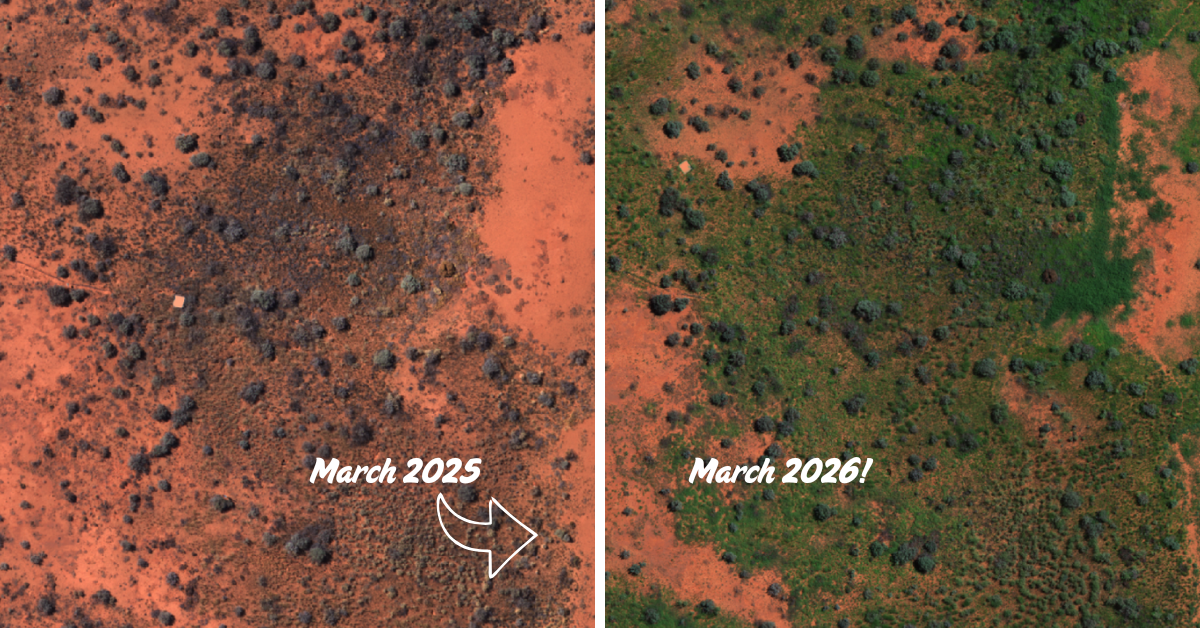
These drone images were taken by Dr Adrian Fisher over the same patch of ground within one of the exclosure areas in March 2025 and again in March 2026. Witchelina received over 250mm of rain across three separate events from late February to early March 2026, already ~100mm above the yearly average.
On what these images demonstrate, Professor Mike Letnic says:
“While some may think of desert landscapes as being dead or lifeless during dry periods, these photos illustrate the capacity of these ecosystems to come to life given the right conditions. This is because desert plants use one of two strategies to persist: endure or evade dry periods.
The blackbush and bluebush shrubs seen in the March 2025 photo use the endure strategy. These plants can survive drought, though they are unlikely to grow during it. After the rain, they renew their leaves and actively grow. This is evident in the greening of their foliage in the March 2026 photo.
However, most desert plants evade dry periods by persisting in the soil as seeds. The seeds germinate following rains, which would explain most of the greening seen in the March 2026 photo. Most evaders are short-lived and complete their life cycle in less than a year, by which time they will have produced seeds that will sit it out until the next rains. The dead tissues from the spent plants will be eaten by termites and other animals in the brown food web, and during dry times will provide an important source of energy for other animals in the ecosystem.”
Certainly, some interesting perspectives and insights into this remote and complex landscape.